Resistors do not have room for printing numbers, so they wear their values as colored bands. Learning to read those bands at a glance is one of those tiny skills that pays off on every single project: grab parts from a mixed bag, verify a value before soldering, or identify what fried on a salvaged board. This tutorial teaches the four-band and five-band systems, then makes you prove your skill with a multimeter and a few practice circuits.
The Four-Band System
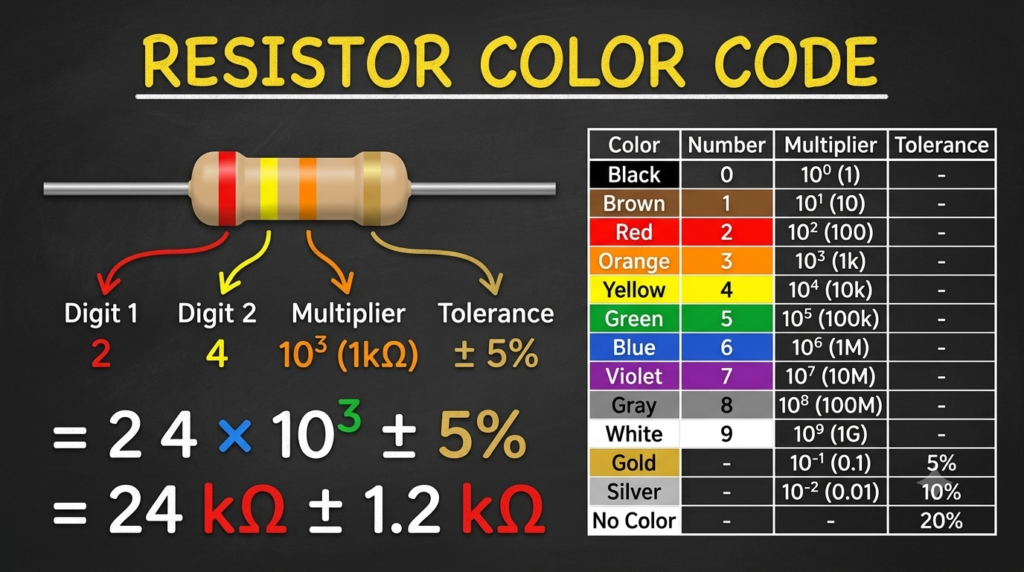
Hold the resistor with the tolerance band (gold or silver, usually slightly separated from the rest) on the right. Reading left to right: band 1 is the first digit, band 2 is the second digit, band 3 is the multiplier — how many zeros to add — and band 4 is tolerance. The digit colors run in rainbow order: black 0, brown 1, red 2, orange 3, yellow 4, green 5, blue 6, violet 7, gray 8, white 9. So yellow-violet-red-gold = 4, 7, two zeros, ±5% = 4700 Ω = 4.7 kΩ. The multiplier band can also be gold (×0.1) or silver (×0.01) for sub-10 Ω values.
| Bands (1-2-3-4) | Calculation | Value |
|---|---|---|
| Red – Red – Brown – Gold | 2, 2, ×10 | 220 Ω ±5% |
| Brown – Black – Red – Gold | 1, 0, ×100 | 1 kΩ ±5% |
| Orange – Orange – Brown – Gold | 3, 3, ×10 | 330 Ω ±5% |
| Yellow – Violet – Red – Gold | 4, 7, ×100 | 4.7 kΩ ±5% |
| Brown – Black – Orange – Gold | 1, 0, ×1000 | 10 kΩ ±5% |
Five Bands: One More Digit
Precision resistors (1% tolerance, blue or beige bodies) use five bands: three digits, multiplier, tolerance. Brown-black-black-red-brown = 1, 0, 0, ×100, ±1% = 10.0 kΩ. The tolerance colors matter here: brown ±1%, red ±2%, gold ±5%, silver ±10%. If band four and five are hard to tell apart, measure — that is what the multimeter is for.
Parts Needed for Practice
- A handful of assorted resistors (a beginner kit is perfect)
- Digital multimeter with resistance range
- 1× 9 V battery or 5 V supply, 1× LED, breadboard
- Paper and pencil for your guesses
Practice Drill: Guess, Then Measure
- Pick five resistors at random and write down your band-reading for each before touching the meter.
- Set the multimeter to ohms (auto-range or 20 k), press the probes firmly on the leads — not your fingers, since body resistance skews high values — and record the truth.
- Score yourself. Within tolerance counts as correct: a 1 kΩ ±5% part reading 982 Ω is a win.
Two readings will trip everyone eventually: values under 10 Ω (gold multiplier) and very high values like 1 MΩ (brown-black-green), where body resistance across the probes drags the reading down noticeably.
Practice Circuit: Light an LED with a Bag-Found Resistor
Challenge: light an LED from 9 V at about 15 mA using only bands. The LED eats 2 V, leaving 7 V; R = 7 / 0.015 ≈ 470 Ω — so hunt for yellow-violet-brown. Find it, wire it, and the LED lights at a safe brightness. Then deliberately grab red-red-brown (220 Ω) and notice the jump in brightness and warmth. You have just done design work: requirement → calculation → bands → part.
Try It in the Circuit Simulator
Our Circuit Simulator includes a resistor color-code helper: pick a resistance and it draws the bands for you — perfect for drilling in the other direction. Then drop that resistor into a simulated LED loop and check the current matches your mental math.
Speed-Reading Tips from the Bench
Three habits make band-reading instant. First, sort a mixed bag by the third band — the multiplier — because it tells you the decade: brown means tens-to-hundreds of ohms, red is kilo-ohms, orange is tens of kilo-ohms, green is mega-ohms. Second, memorize the six E12 values that cover most hobby circuits: 220 Ω, 330 Ω, 470 Ω, 1 kΩ, 4.7 kΩ and 10 kΩ — you will recognize them on sight within a week. Third, keep a labeled resistor organizer; thirty seconds spent filing parts correctly saves ten minutes of squinting later. And when a band is genuinely unreadable, the multimeter settles every argument in five seconds — there is no prize for guessing.
Troubleshooting
- Cannot tell which end to start from: the tolerance band is spaced apart from the group; when in doubt, measure.
- Meter shows overload on ohms: the resistor may be out of range (try a higher range) or the part is open/failed.
- Reading changes when you grip harder: your fingers are in parallel with the part — hold one lead only, or use clips.
- Faded or ambiguous colors: heat and age brown everything; trust the meter over tired eyes.
Safety Notes
- Never measure resistance on a powered circuit or a charged capacitor — the ohm range injects its own small current and can be damaged by external voltage.
- Discharge any circuit before probing, and keep practice to battery voltages.
- Resistors pulled from mains equipment may carry residues of high voltage circuits — discharge and clean salvaged parts before handling.
Conclusion
Color bands are no longer a mystery code but a label you read like text — and you verified every guess against an instrument. Pair this skill with Ohm’s law and you can walk up to almost any simple circuit and understand what its designer intended. Next, put your new reading skills to work choosing resistors for series and parallel LED circuits.