One LED is easy. Two LEDs force a decision that every electronics designer makes daily: series or parallel? The wrong choice wastes battery, unbalances brightness, or burns parts out — and the right choice depends on your supply voltage and your goal. In this tutorial you will build both arrangements side by side, measure their currents, and learn the one rule that keeps parallel LEDs honest: every branch gets its own resistor.
The Core Difference
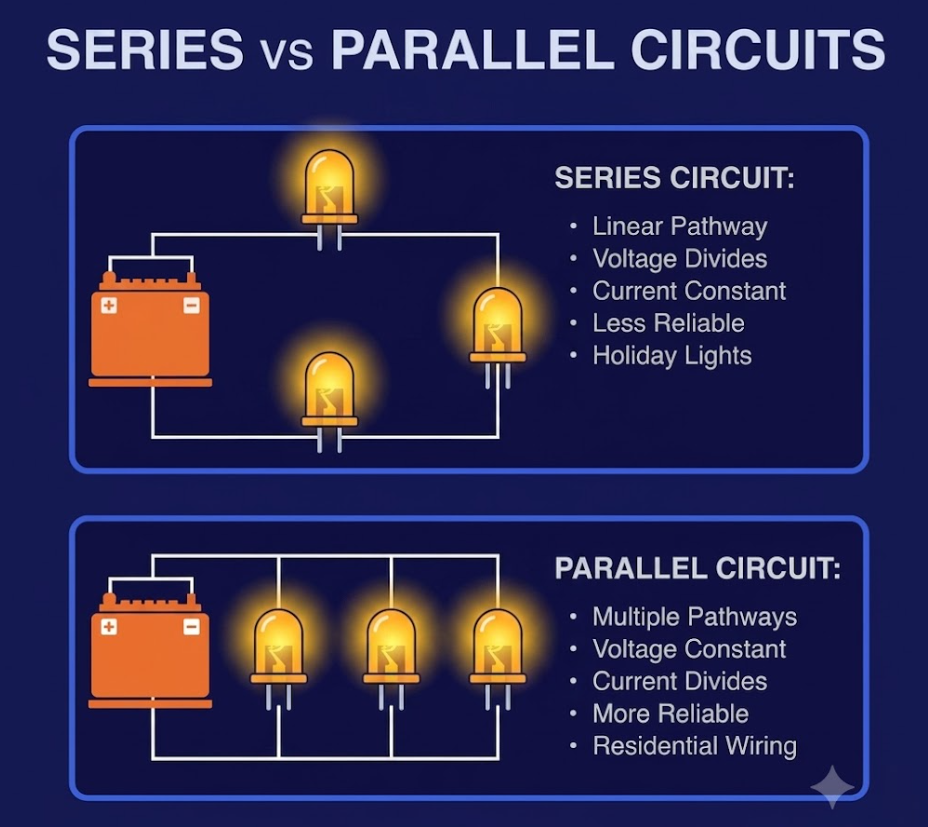
In series, the same current flows through every component, and the supply voltage divides among them. Three LEDs with 2 V forward drops need at least 6 V plus headroom for the resistor — a 9 V battery works, two AA cells (3 V) never will, no matter how you wire them. In parallel, every branch sees the full supply voltage and draws its own current, so three LEDs at 15 mA each pull 45 mA from the source. Series saves current but demands voltage; parallel works at low voltage but multiplies current draw. Battery projects think hard about this trade.
Parts Needed
- 1× 9 V battery with snap (or 5 V USB supply)
- 6× identical red 5 mm LEDs
- Resistors: 1× 150 Ω, 3× 220 Ω (red-red-brown), 1× 470 Ω for comparison
- Multimeter, breadboard, jumper wires
Build A: Three LEDs in Series
Wire a single loop: battery+ → resistor → LED1 → LED2 → LED3 → battery−. Three red LEDs drop ≈6 V total, leaving 3 V across the resistor. For 15 mA: R = 3 / 0.015 = 200 Ω, so the nearest value, 220 Ω, gives ≈14 mA. All three LEDs glow at equal brightness because the exact same current must pass through each.
| Arrangement | Supply Needed | Total Current | Resistor |
|---|---|---|---|
| 3 LEDs series @15 mA | ≥ 7 V (9 V used) | 15 mA | One 220 Ω shared |
| 3 LEDs parallel @15 mA | ≥ 3 V (5 V or 9 V used) | 45 mA | One 220 Ω per LED |
Build B: Three LEDs in Parallel — the Right Way
Now give each LED its own private resistor, then join the three branches across the supply. On 9 V: each resistor drops 7 V at 15 mA — 470 Ω lands you at ≈15 mA per branch, 45 mA total. Wire it and compare: the same brightness as series, but three times the battery drain. That is the price of running LEDs from a voltage too low to stack them.
The Trap: One Resistor, Three Parallel LEDs
Beginners often share one resistor across three parallel LEDs. Try it on the breadboard and observe: brightness is uneven, and one LED hogs current. No two LEDs have identical forward voltages; the one with the slightly lower Vf grabs more current, gets warmer, its Vf drops further, and it grabs more still — thermal runaway in miniature. The shared resistor can only limit the total, not the split. This is why every parallel branch needs its own resistor, and why commercial LED products bin their LEDs by forward voltage.
Measure It Like an Engineer
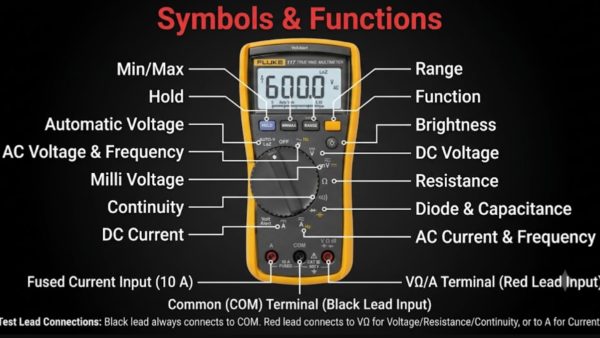
With the multimeter in current mode, measure the battery current of Build A (≈14 mA) and Build B (≈45 mA). Then measure across one LED in each build: ≈2 V everywhere. Finally compute battery life: a 550 mAh 9 V alkaline runs the series string about 39 hours, the parallel bank about 12 — same light output, triple the consumption.
Try It in the Circuit Simulator
This comparison is perfect for our Circuit Simulator: build both circuits side by side on the same canvas, press Run, and read each loop’s current in the status bar. Delete a resistor from a parallel branch and watch that LED shoot past 30 mA and burn out — the runaway lesson, with zero smoke.
Troubleshooting
- Series string dark: supply too low — add the LED forward voltages plus 1–2 V headroom and check against your supply.
- One LED reversed in the string: the whole series loop goes dark; series is all-or-nothing.
- Parallel LEDs unequal brightness: check each branch has its own resistor and identical value.
- Resistor hot: on 9 V a 220 Ω parallel-branch resistor dissipates 0.22 W — near a 0.25 W part’s limit; use 470 Ω branches or a lower supply.
Safety Notes
- Never parallel LEDs without individual resistors — even if it “works” on the bench, it fails in the field.
- Watch total current from your source: a USB port can typically spare 500 mA, a coin cell barely 20 mA.
- Blue and white LEDs drop 3–3.4 V, not 2 V — redo the math before mixing colors in series strings.
Conclusion
Series or parallel is no longer a guess: count the voltage for series, count the current for parallel, and give every parallel branch its own resistor. These are the exact calculations behind LED strips, backlight panels and holiday lights. Your multimeter already agrees with your math — next stop, capacitors, where time enters the picture.